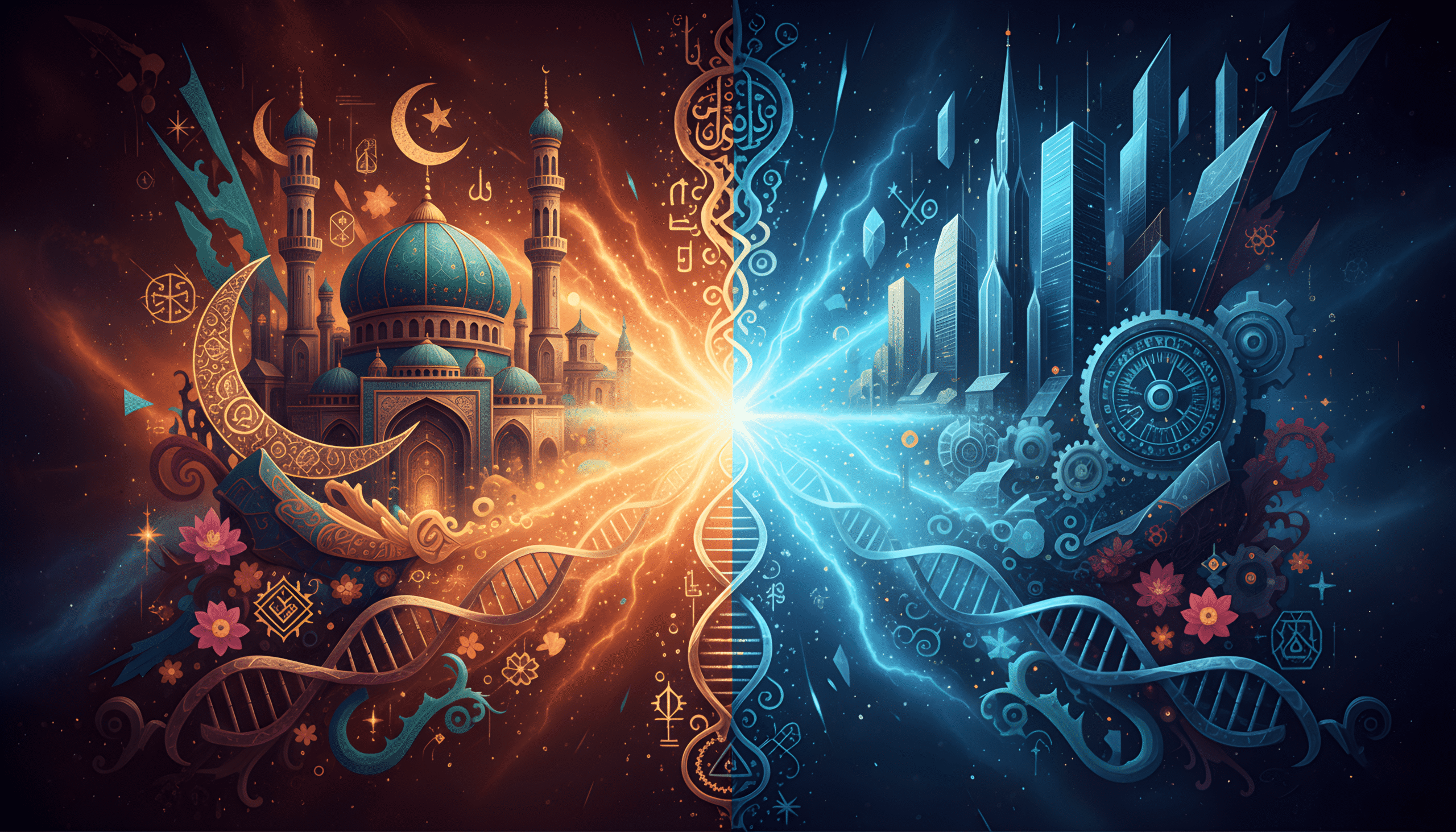

Love is one of the very select few concepts in this world that come dangerously close to the concept of perfectionism. The nature of perfectionism is such highly, almost infinitely abstract that it makes it impossible to even interact, let alone examine the concept of perfectionism. Love, however, is therefore a very intriguing concept because while at one hand, love claims to interact with the innermost workings of the concept of perfectionism, at the other hand, simultaneously, it is observed being interacted with in the most opposing field of perfection that could exist, the field of empiricism and rationality.
To understand this claim and relation of love with perfectionism, we need to first understand the core principals of how we interact with our world. On one end we have the concept of perfectionism which dictates that life, humanity, the universe and all of reality, is so infinitely small in front of the concept of perfection that our reality cannot even begin to fathom the true extent of perfection let alone reach it. At the same time however, perfectionism claim that the only direction of reality, the very shape of reality is deformed and skewed in the direction of perfectionism itself. Hence, simmilar to plato’s concept of the perfect realm, the concept of perfectionism claims that our reality is a mere fragmented reality of that true realm of perfection and hence all sense and direction of “good” must be aimed towards those cosmos of perfection, yet however, perfection goes on to persistently claim that it is practically impossible for our reality to reach that realm. This is perhaps the curse of our reality, that in a weird way, we human beings mirror. To constantly compare ourselves with a version of reality that, as far as we are concerned, does not even exist. This is what gives meaning and direction to our reality, yet this is also what takes away meaning and direction from our reality completely.
This is the rather arrogant claim of perfectionism, mortal intellect however opposes it and introduces rather much more crude concepts of perception of our reality. Empiricism and rationality, the frontiers of western philosophical though, especially post enlightenment, these concept claim that reality is only that which can be captured within mortal understanding, anything beyond that is fiction. Empiricism claims that only those elements of reality that can be perceived within our primary senses are indeed factually elements of reality. Rationality takes it one step further to claim that perhaps those elements that cannot be seen or heard even, but can be brought within reason due to intellectual deduction and logic, such concepts are also to be accepted. This version of reality leaves little to no gap for abstract concepts like perfectionism. In the history of philosophy, often, concepts have taken either one or the other side.
Perhaps this is where love is unique and intriguing. While the perfectionist would define love as such a cosmologically significant event, with at times some claiming love to be the very reason of existence. Rational on the other hand, connects all the dots scattered across human evolution and history to put together a rather much less dramatic picture. Evolutionary psychology claims that concepts of love are essentially basic structures of civilisation that helped us form the most stable versions of civilisation. With natural selection even proposing that any variant of civilisation that did not conform to these very standards and structures that are otherwise defined as love, such civilisation would have collapsed on its own. The concept of these structures proposes its bases on the concept of mutual benefit for individuals as well as society. Hence this mutual benefit would form these structures or relationships that involved an exchange of services. Perhaps, wolves got domesticated because we provided them food in return of security. So did cats start to live around societies that would award them for keeping mice away. Similarly even much more complex relationships can be defined with rather simple establishment of exchange of services. Our specie soon realised that guardians need to provide for children until they are old enough to fend for themselves, hence ensuring our survival. And lastly, perhaps the most complex of all relationships, a romantic relationship was the basis of exchange of much more complex services, depending on the social and civilisational culture, these could be anything from basic security and provision, to social status and sexual satisfaction. These elements became much more vivd when we observe how selective all species are in choosing a partner, with a long list of preferences, ensuring, in its essence, that this relationship of trade would have the maximum potential for success, in all senses of the word.
While both these concepts are heavens apart, the daring of love is such that it claims to have its hand stretched out in the heavens for perfectionism, while having its roots all the way back into the empiric world. This is perhaps the most dangerous of claims that love makes, where it talks about an unconditional love. Love claims, that while to the rational eye love might seem like only an exchange of services, in its perfect form, love breaks these bounds of mutual benefit and claims unconditionality. It claims that love is selfless, not wanting the best for themselves, but for the other, at times even when it comes with a cost for them to pay against themselves. It claims that even when a person is not able to provide one or more of these services, love continues and hence in doing so, by becoming unconditional, it breaks the bounds of rationality.
To thoroughly investigate the claim of love’s unconditionality, one must understand the very conditions we observe while interacting with the universe. Because whether or not is love divine remains secondary, against the fact that our primary, and perhaps only, way of interacting with the world is empiric and rationale. Hence even the most heavenly satisfaction delivered by love, must be felt through our primary sense. This is crucial because it helps us dissect the claim of love when it says that it loves a person for who they are, and not for their ability to provide a service. Because then the argument remains who is that very person that love claims to love. The theological concept of essence and attributes is an excellent marker to dissect it. The concept proposes that everything has a core identity which is its essence. But at the same time it has several attributes. For example a person in its core is the essence, but all its characteristics are its attributes such as how he talks, how we walks, treats others, etc. While it is difficult to pinpoint exactly where, but there must be a point beyond which, despite how much love claims that it remains unchanged and unconditional, if every single characteristic, including their looks and mannerisms are swapped with a total stranger, there must be a certain point beyond which that person would not be the same person you loved in the first place. But at this point, its difficult to tell who did you love, the essence or the characteristics. Because you cannot claim to love the essence of that person as there is no way to reach that essence. As far as we are concerned, your former lover would be a completely different stranger now. And if you claim to still love this person, who is now an exact copy of another stranger, is it still loyal to the original set of essence and characteristics of that person you claimed to love? Simmilar to the ship of Theseus, this is a tough dilemma with no definite answer. However, one idea remains clear, that since there is no way to even interact with the essence of a person, there is little gravity to love’s claim for being unconditional.
However, there remains an argument to be made that whether or not the incapacity to love beyond a complete different set of characteristics is a human weakness or one of love itself. Nevertheless, the claim of love is not completely fictitious. Because today, we might not need wolves to protect us or cats to keep away mice, yet we keep them around because we love them. Because even after children have grown up to fend for themselves, they still love and care for their parents. Because despite not complete, but times and times again love has proved its worth every single time one a lover has not abandoned another in dire times.
Perhaps there is little understanding about perfectionism, but more about love itself from these analogies. But then again, such is the nature of perfection, where it itself remains unattainable but sheds light onto others to guide their way.