
On the Need to Belong, the Impossibility of Justice, and the Curse of the Philosopher
by Salman Tahir
The Tribe and Its Comforts
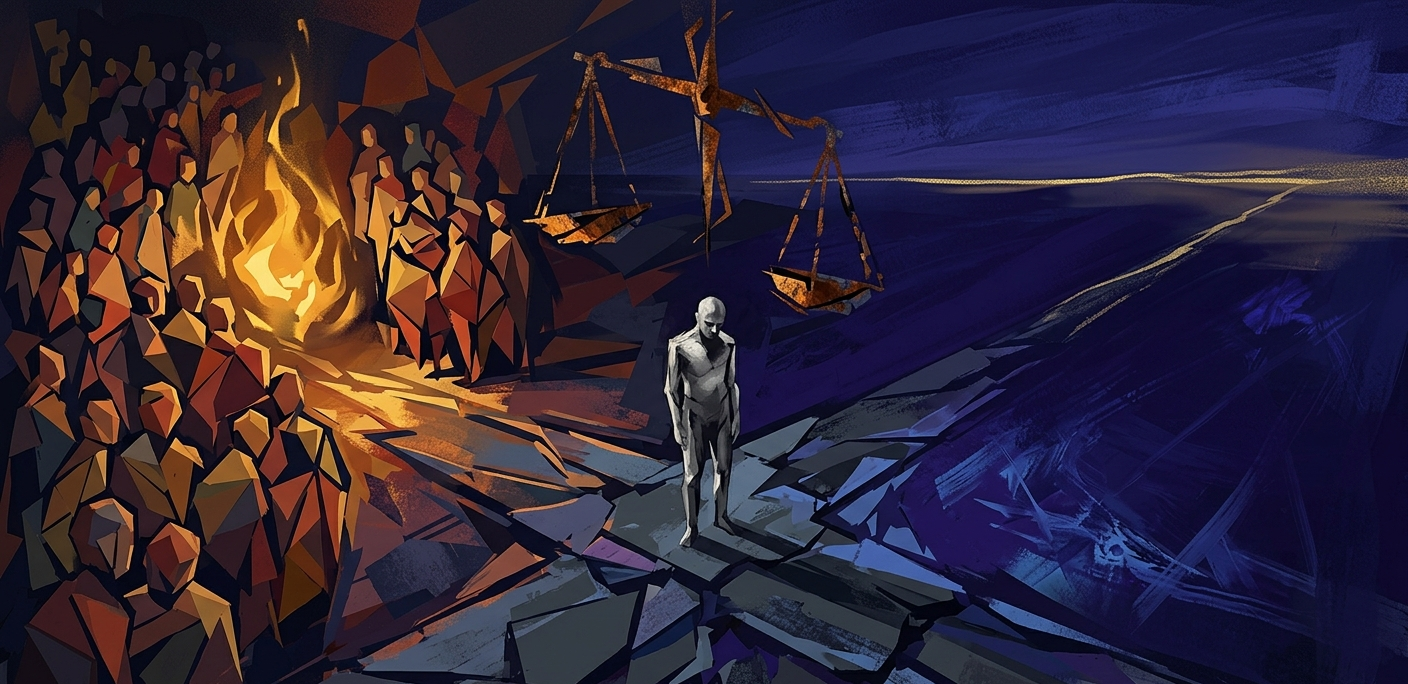
There is something deeply, almost tenderly human about the need to belong. Long before there were nations or creeds or political parties, there were fires, and around those fires, people who had chosen, instinctively and without deliberation, to define themselves against the dark. The tribe is not an accident of history. It is a necessity of psychology. To belong to something is to be held by something, and to be held is to be spared the vertigo of standing alone in a world that offers no guarantees and no explanations.
This is why people subscribe: to ideologies, to nations, to religions, to ethnicities, to parties whose slogans they have never fully examined. Not because they are stupid, and not always because they are cowardly, but because the alternative is a kind of exile that most human beings are not built to endure. The tribe gives a name to the enemy, a language for the self, a history that flatters and a future that promises. It says: you are here, you are right, and the others are what stand between you and the good place.
This arrangement is psychologically efficient and morally catastrophic. Because what the tribe also does, quietly and without announcement, is relieve its members of the obligation to truly think. Thinking, real thinking, the kind that does not stop at the boundary of one’s own comfort, is dangerous work. It may lead somewhere unwelcome. It may reveal that the story told about the enemy is also the story the enemy tells about you. And so the tribe, any tribe, quietly discourages that kind of thinking. It rewards loyalty. It mistakes agreement for wisdom and dissent for betrayal. The result is a world full of people who are absolutely certain they are on the right side, all of them, simultaneously, with perfect sincerity, and all of them, in some meaningful sense, wrong.
The Stranger Who Sees
Occasionally, someone refuses the comfort. Call it temperament, call it a wound that never let them settle, call it philosophy; whatever the cause, there are those who insist on questioning everyone, including the side that would have them, including the cause they were born into, including themselves. They apply the same scrutiny to their own tribe that they would apply to its enemies, and in doing so they commit an act that most communities treat as a form of treason.
Albert Camus wrote a novel about such a person, a man so incapable of performing the expected emotions that society eventually sentences him to death, not really for the crime he committed, but for the sin of refusing to pretend. The Stranger is not a villain. He is simply honest in a world that cannot afford honesty, clear-eyed in a world organized around useful illusions. He is punished not for what he did but for what he is: someone who will not belong.
The genuine philosopher, one truly committed to impartial examination, becomes this stranger. By questioning everyone equally, without the shelter of prior allegiance, such a person earns the suspicion of all sides. The nationalist calls them a traitor. The revolutionary calls them a coward. The religious call them a blasphemer. The secularist calls them naive. There is no group that will fully claim them, because no group can survive the scrutiny they bring. And so they wander, intellectually homeless, morally orphaned, belonging nowhere by virtue of being willing to look everywhere.
To question everyone equally is to be claimed by no one. And to be claimed by no one, in a world organized entirely around belonging, is its own particular punishment.
This is not a romantic condition, whatever certain traditions have tried to make of it. It is genuinely painful. Human beings are not designed for that kind of solitude. But it is also, in a specific and important sense, the most honest position available. And that honesty eventually leads the philosopher to a realization so uncomfortable that even they would rather not arrive at it.
The Scale That Cannot Be Righted
Imagine that at some point, call it the first crime, the original transgression, the moment when one person took from another what was not theirs to take, the world was tipped out of balance. Not metaphorically, but in some deep structural sense. Justice was owed, and justice was not given. A debt was created in the ledger of human affairs that has never been settled and may never be settable.
Because here is the problem: injustice cannot be undone without invoking something that is itself not entirely just. The tools available to the wronged are not clean tools. Revolt is violent. Resistance causes harm. Revolution devours its children. Every liberation movement in history has had its massacres, its purges, its betrayals of the very principles it announced. This is not cynicism; it is observation. The oppressed, upon gaining power, have a troubling tendency to become the oppressor, not because they are uniquely corrupt but because the machinery of power is itself corrupting, and because the habits of injustice are far easier to inherit than to escape.
Consider what is being asked of anyone who chooses to fight injustice through resistance. They are being asked to invoke violence, or subversion, or acts that would be condemned as criminal in any context other than this one, in the name of a better future that is not promised. The justice they seek is deferred, hypothetical, contingent. The injustice they commit is immediate and real. And when we ask whether that trade is justified, we find ourselves unable to give a clean answer, because the answer depends entirely on whether the future they are working toward actually arrives, and in the form they imagined, and without introducing new cruelties of its own. History suggests this is rarely the case.
Isaiah Berlin spent a career arguing that genuine human values are not merely difficult to reconcile but structurally incompatible: that liberty and equality, justice and stability, individual dignity and collective survival pull in directions that cannot all be honored simultaneously. There is no arrangement that satisfies all of them. Any political order is, at bottom, a decision about which values to sacrifice, and the sacrificed values do not disappear; they accumulate, they become grievances, they eventually become the justification for the next upheaval. The scale tips, and tips, and tips again, never finding rest.
What this means is something genuinely unsettling: there may be no such thing as a truly just action in the world as it actually exists. There are better actions and worse ones, more defensible choices and less defensible ones. But the category of the pure, the act that rights a wrong without introducing a new one, the revolution that liberates without oppressing, the justice that leaves no injustice in its wake, may simply be empty. Not difficult to achieve. Empty. Structurally unavailable.
The Good Place
The word utopia, coined by Thomas More in 1516, is a pun. It sounds like the Greek eu-topos, the good place. But it is actually ou-topos. No place. The good place is, by its very name, nowhere. More may have intended this ironically, or gently, but the etymology has since come to feel like a diagnosis. Every civilization has imagined it: the harmonious city, the just kingdom, the classless society, the world redeemed. And every attempt to build it has produced something other than what was imagined, usually something that required enormous suffering to construct, and that collapsed, or hardened into tyranny, long before anything resembling the vision was achieved.
This is not an argument for passivity or for the preservation of the status quo. The status quo is often monstrous, and those who defend it in the name of realism are frequently just defending their own comfort. But it is an argument for honesty about what is being attempted and at what cost. The good place is a horizon; it recedes as you approach it. It is real enough to orient movement, to give direction, to make certain sacrifices feel meaningful. But it is not a destination. It cannot be arrived at. And those who claim to have arrived, those who stand at the gates of their new order and announce that the long work is finished, are almost invariably announcing the beginning of a new catastrophe.
Humanity keeps building these gates. It keeps writing these announcements. It keeps tipping the scale.
The Paralysis and Its Consequence
So the philosopher stands, at last, with the full weight of all this knowledge, and faces a choice that is not really a choice. To act is to enter the cycle: to pick a side, dirty the hands, commit some lesser violence in the name of some greater good that may never arrive. To abstain is to allow the existing injustice to continue unchallenged, which is its own form of complicity, its own form of harm. Max Weber, writing in the shadow of a world that had just destroyed itself, called this the inescapable burden of political life: the person of genuine conscience eventually discovers that no path is clean, and that the refusal to walk any path is not an exemption from moral consequence but simply a different kind of failure.
The philosopher who has questioned everyone equally finds that this very quality, the impartiality that made them honest, now makes them useless, or nearly so. They cannot throw themselves into any cause without reservation, because they know too much about what every cause eventually does with itself. And yet they cannot stand aside, because standing aside is also a decision, also a vote, also a weight placed on one side of the scale. There is no neutral ground. The absence of action is itself an action, and it tends, in the real world, to favor whoever is already winning.
The clearest mind turns out to be the most trapped. To see everything is, in the end, to be free to do almost nothing.
This is the cruelest irony at the center of the whole condition. The person most capable of seeing the situation clearly is the least capable of acting within it decisively. The person most aware of the moral costs of any choice is the least able to make one with conviction. And the world, indifferent to this internal drama, continues its business regardless, injustices accumulate, sides are chosen, scales tip, while the philosopher stands at the crossroads, paralyzed by the accuracy of their own perception.
There is no resolution to offer here. This is not an essay with a redemptive turn, a closing argument that lifts the burden and points toward morning. The honest thing is to say that the trap is real, that the paralysis is warranted, and that it carries a cost, and then to say, also honestly, that the cost of paralysis is not zero, and that knowing this does not make it easier to move. Choosing the lesser evil is still choosing evil. Not choosing is also choosing evil. The scale tips either way. It has always tipped. And the dream of a world where it finally, permanently, rests level, the good place, the no-place, persists in the human imagination with a stubbornness that cannot quite be called hope and cannot quite be called delusion.
Perhaps that is the most honest thing that can be said about it: it is the yearning of a species that knows, somewhere beneath its politics and its prayers and its philosophies, that it has never quite been equal to the world it imagined for itself. And has never, entirely, stopped imagining it.